Blog
What Is a Fractional CMO? The Complete Guide for B2B Companies (2026)
April 22, 2026
May 13, 2026
All Blogs 5 Questions a Fractional CMO Asks in the First 30 Days
Walking into a new business for the first time is a bit like stepping onto a construction site mid-project. You don't start by picking paint colors or debating office layouts. You check the foundation, study the blueprint, and figure out why progress has slowed.
That is the difference between a marketing consultant and a fractional CMO. A consultant might hand over recommendations and move on. A fractional CMO stays, owning the problem, aligning the pieces, and making sure the structure actually holds.
Here are the five questions your Fractional CMO will ask during their first month to get your growth back on track.
Marketing to the wrong audience is the fastest way to blow a budget. Often, a company thinks they are selling to one persona, but the data shows another group is actually closing faster and staying longer. If your Ideal Customer Profile (ICP) was defined by "gut feel" rather than actual data, it is time for a correction. We analyze the last 20-50 deals to find patterns in industry, company size, and buyer roles.
What that analysis almost always reveals: when the ICP is wrong, everything built on top of it is wrong too, the positioning, the messaging, the content, the channels. Fix the targeting, and the brand starts to make sense.
What to pull: firmographic patterns in won deals, retention and LTV by segment, match between the ICP on paper and deals in the CRM.
This sounds obvious until you ask it in a room and three people give three different answers. Marketing says it's the webinar series. Sales says it's referrals. The CEO says it's the partnership signed eighteen months ago. Everyone is technically right. Nobody is fully right.
Before a fractional CMO touches a brief or reallocates any budget, they need one clear answer: what is the business actually trying to achieve, and what is marketing's specific role in getting there? Revenue target, growth timeline, competitive context – and more importantly, whether marketing is expected to own the pipeline, build brand, or both.
That alignment does not exist in most companies by default. It has to be surfaced, written down, and agreed on before anything else moves.
Which is why this question does not just reveal where to invest. It reveals where the budget has been quietly leaking for months.
What to pull: revenue targets by product and segment, customer acquisition cost (CAC) and lifetime value (LTV), leadership's view on how marketing success is defined.
Identifying which channels, products, or segments are actually driving measurable results allows a fractional CMO to double down on what works. In B2B, the black box of reporting can be messy - and most teams are measuring what is easy to measure, not what actually tells them something useful.
If more than 40% of your conversions are tagged "direct" or untracked, you are operating in the dark funnel. This lack of visibility makes it impossible to calculate ROI effectively. Mapping out the B2B buyer journey – from initial awareness to the closed deal – is essential to see where prospects are dropping off and which touchpoints are actually moving them forward.
What to pull: channel contribution by source, multi-touch attribution data, conversion rates by lead source.
The 80/20 rule almost always applies to B2B marketing: 80 percent of your impact usually comes from 20 percent of your activities, and the rest are quietly draining budget. The question is whether anyone knows which is which.
A fractional CMO goes line by line, every campaign, every channel, what was spent, what closed. And within that, how much came from organic channels versus paid. Both matter, but they tell you different things about what to do next.
A useful benchmark: LTV to CAC should sit at 3:1 or better. If it does not, spend allocation is the first place to look.
What to pull: spend vs. pipeline generated by campaign, CAC and cost per opportunity by channel, content asset use in closed deals.
This one deserves a dedicated conversation, and most teams will not love what comes out of it. Ask marketing: what is an MQL? Ask sales: what is an SQL? If the answers differ - or if one team does not have a clear answer - you have found the leak.
When both teams are measured on different things and using different criteria, leads fall through the cracks. Research indicates that MQL-to-SQL conversion for aligned teams typically sits between 12% and 21%. Anything consistently below 10% is a signal that the handoff is broken, not that the leads are bad.
Response time matters just as much. Studies show that leads followed up within 24 hours are significantly more likely to convert. If MQLs are sitting in a queue for days before sales touches them, no amount of campaign optimization will fix the pipeline problem.
What to pull: shared MQL/SQL definitions, SLAs on lead follow-up, funnel conversion rates at each stage.
A good fractional CMO is not hired to arrive with answers. They are hired to ask the right questions and then do something about what the answers reveal.
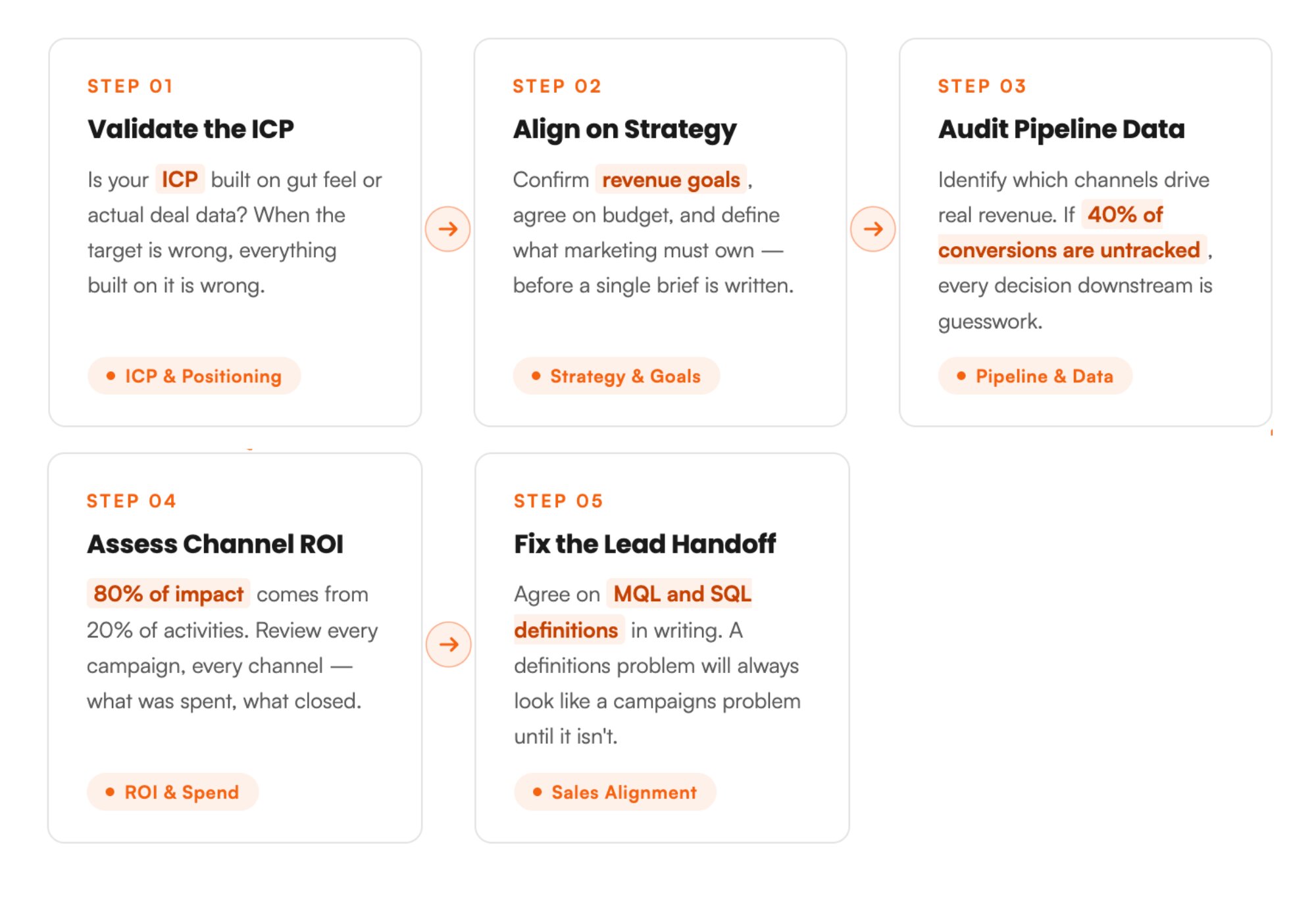
These five areas – business goals, revenue sources, marketing ROI, sales-marketing alignment, and ICP – form the diagnostic layer that any serious fractional marketing strategy has to be built on. Here is what working through that layer actually looks like:
Validate the ICP: Analyze actual customers against the target ICP. Refine buyer personas and messaging. Shift targeting and content toward the best-fit audience.
Align on strategy: Confirm top-line goals, budget, and marketing's KPIs. Document leadership priorities and assumptions.
Audit pipeline data: Pull CRM and analytics reports. Identify top revenue channels and customer segments. Clean up "direct" and unknown attribution buckets.
Assess channel ROI: Review spend vs. deals closed for every marketing campaign.
Fix the lead handoff: Ensure MQL and SQL definitions and SLAs exist and are agreed on by both teams. Check conversion rates and response times. Establish regular sales-marketing syncs.
If you want to go deeper on what that embedded, execution-focused model actually looks like, From Consultant to Co-Pilot: The Fractional CXO Advantage is worth your time.
At The Fractional CMO Company, this is exactly where we start, not with a slide deck, but with the questions that matter. Let's start with the right questions.
A Marketing Qualified Lead (MQL) is a prospect who has demonstrated enough interest in a product or service to be considered ready for further marketing engagement, but not yet passed to sales. MQL criteria typically include actions such as downloading a resource, attending a webinar, or reaching a defined lead score. The threshold varies by company but always reflects a signal of intent rather than confirmed buying readiness.
A Sales Qualified Lead (SQL) is a prospect that the sales team has reviewed and accepted as a genuine opportunity worth pursuing. An SQL has typically met defined criteria around budget, authority, need, and timeline. The handoff from MQL to SQL is one of the most consequential moments in B2B revenue - when the criteria are unclear or unagreed on between teams, qualified leads consistently fall through the gap.
An MQL is qualified by marketing based on behavioral interest signals such as content downloads or event attendance. An SQL is qualified by sales based on confirmed buying intent and readiness criteria including budget and decision-making authority. The distinction matters because it defines who owns the lead, what happens next, and how both teams are held accountable across the revenue funnel.
Customer acquisition cost (CAC) is the total sales and marketing spend required to acquire one new paying customer, calculated by dividing total acquisition costs by the number of new customers in a given period. It includes ad spend, salaries, tools, and agency fees. A healthy LTV to CAC ratio for B2B businesses is 3:1 or better - meaning the customer generates at least three times what it costs to acquire them.
Lifetime value (LTV or CLV) is the total revenue or profit a business can expect from a single customer across the entire relationship. It is calculated by multiplying average purchase value, purchase frequency, and customer lifespan. LTV determines how much a business can sustainably spend to acquire a customer, and is a core metric for evaluating the long-term health of a B2B growth model.
May 13, 2026
How relevant and useful is this article for you?