Blog
What Is a Fractional CMO? The Complete Guide for B2B Companies (2026)
April 22, 2026
May 22, 2026
All Blogs Go-To-Market Strategy: A Practical Playbook for 2026
Imagine walking into a room where everyone is wearing noise-canceling headphones. You can shout your value proposition until your voice cracks, but nobody hears a word. This is the reality of B2B selling in 2026, where buyers have built digital walls specifically to keep out the flood of endless cold emails and "personalized" ads that all sound exactly the same.
The old playbook, the one that says more volume equals more growth, has stopped working. Winning in this environment means stopping the habit of acting like a noisy salesperson and building the reputation of a trusted neighbor instead. This playbook is your map for doing exactly that.
A B2B go-to-market strategy is the integrated system by which a company brings its product or service to the right buyers, through the right channels, with positioning and messaging that drive revenue. It is the framework connecting awareness, preference, pipeline, and revenue, with one accountable owner and one shared measure of success.
The traditional GTM model built around product, market, and channels no longer reflects how B2B buying actually works. Buying decisions now involve multiple stakeholders, and much of the evaluation happens through AI search, peer recommendations, dark social, and private communities before a buyer ever speaks to sales.
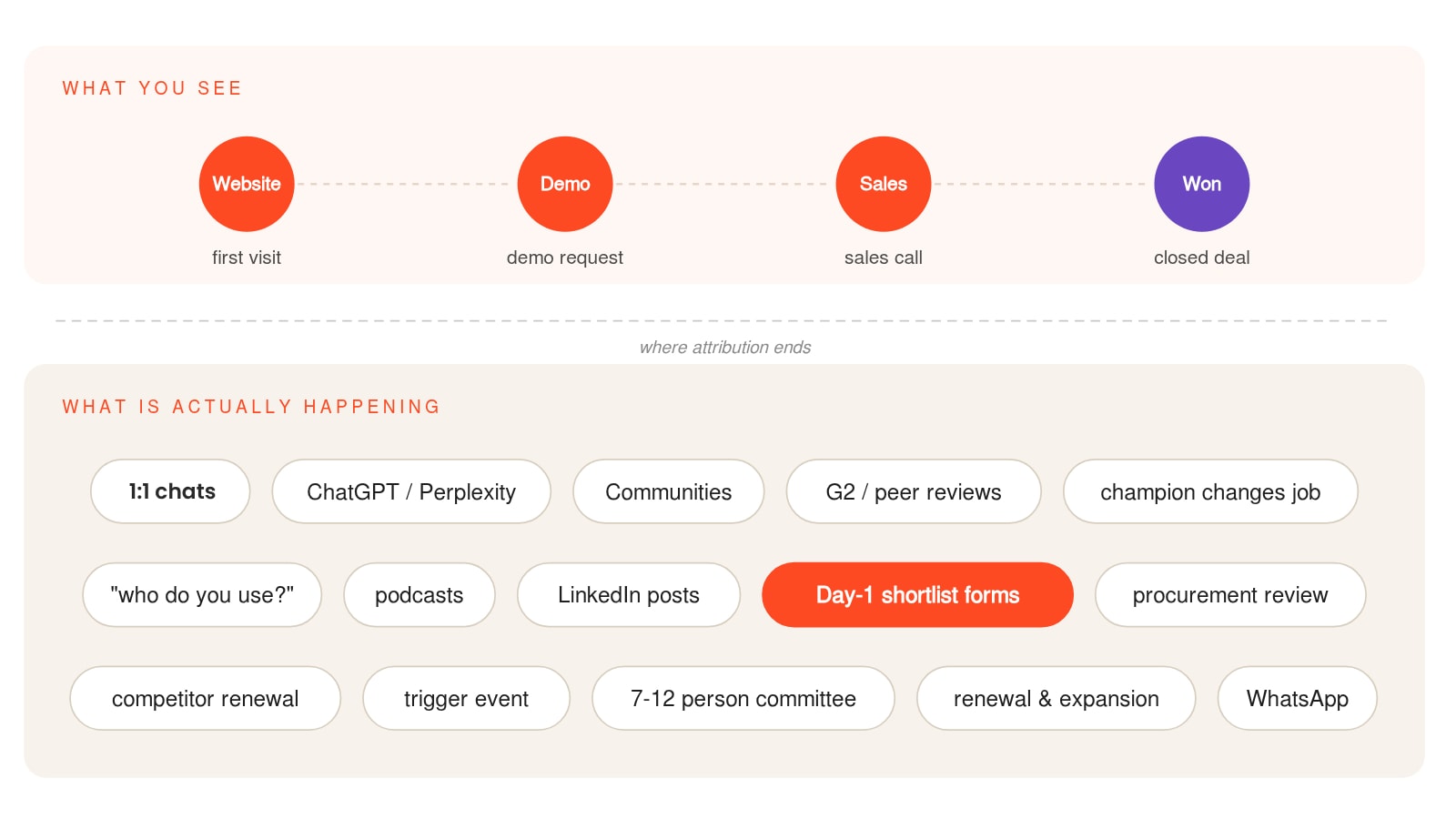
The top of that picture is what your CRM can see. The bottom is everything else, and that is where most of the decision is made. Every step of the playbook below is shaped by that fact.
Most B2B go-to-market strategy frameworks hand you a checklist. This one starts with why the standard approach has stopped working, and builds from there.
Most B2B companies already have a clear Ideal Customer Profile (ICP). They know the industries, company sizes, budgets, and decision-makers they want to target. The problem is that firmographics alone do not explain buying intent.
Two companies can match the exact same ICP and behave completely differently. One may ignore your outreach for months, while the other starts evaluating vendors immediately. The difference is usually not company size or industry. It is whether a triggering event has created urgency inside the business.
That is why modern GTM teams are adding an intent layer on top of their ICPs. Instead of only asking, "Who fits our market?" they are also asking, "What specific business problem or trigger event makes this company likely to act right now?"
The Move: Layer intent signals on top of your ICP. A new leadership hire, a recent funding round, or a public announcement about a strategic shift are all signals that a buying window may be opening. These are the accounts worth prioritizing first.
Knowing which accounts are likely to act is only half the equation. The other half is making sure that when a triggering event hits, your brand is already the one they think of.
And this is where timing becomes the real variable. The 95-5 rule states that only 5% of your Total Addressable Market (TAM) is actively looking to buy at any given time. When the other 95% finally enter a buying cycle, they will not search for the best solution available. They will reach for the most familiar one.
This is why brand and demand generation cannot live in separate budgets with separate goals. Demand generation does not create trust. It harvests trust the brand has already built. When conversion rates fall and CAC climbs, most teams look for a channel fix. The real problem is usually upstream: the brand has not given buyers a reason to trust it before the campaign lands.
The Move: Identify the one problem your buyers lose sleep over and make your brand the most credible voice on it. Your content, messaging, and positioning all follow that answer.
Think about the last time you researched something before making a significant purchase. You probably did not just Google it once and decide. You searched, you asked an answer engine, you checked what came up in a summary, and somewhere in between you asked a colleague who had already been through it.
Your B2B buyers are doing exactly the same thing, and they are doing it across three distinct layers.
Traditional SEO: Google rankings still matter and organic visibility drives the first wave of awareness. If you are not on page one for your category's core queries, you are already behind.
Answer Engine Optimization (AEO): Platforms like Claude, Gemini, ChatGPT, and Perplexity summarize and recommend without the buyer clicking a single link. Your content either gets cited in that answer or someone else's does.
Generative Engine Optimization (GEO): Tools like Gemini synthesize multiple sources into one response. The brands that get woven into that narrative are the ones with structured, authoritative, well-cited content.
Most B2B brands have a strategy for the first layer and almost nothing for the other two. That is a visibility gap that compounds over time, because every buyer who forms an opinion about your category through an AI-generated answer is a buyer your demand gen never had a chance to reach.
The Move: Audit your visibility across all three layers. Search your most important buyer queries in ChatGPT, Perplexity, and Google. If you are not appearing, your content structure, your schema markup, and an llms.txt file on your website are the fastest places to start.
The LTV to CAC ratio is still the right long-term health check, but the metric that revenue leaders and investors are centering planning conversations around in 2026 is the GTM Efficiency Factor. It answers the most direct question in any strategy review: for every dollar put into sales and marketing, how much new recurring revenue is coming back?
GTM Efficiency Factor = Net New ARR (Current Period) / Total S&M Spend (Previous Period)
The prior period's spend is used intentionally. It accounts for the lag between when you invest in GTM and when that investment converts to closed revenue.
| Score | What It Tells You |
|---|---|
| Above 1.5 | Strong efficiency. Increase investment with confidence. |
| 0.8 to 1.5 | Healthy baseline. Optimize channel mix and conversion points. |
| 0.5 to 0.8 | Acceptable at early growth stage, but monitor closely. |
| Below 0.5 | The system is leaking. Diagnose before adding more spend. |
When this score comes back low, the most productive response is to map where the system is breaking down, whether at ICP targeting, messaging clarity, the handoff between sales and marketing, or post-sale expansion, and fix that before funding more of a motion that has not yet proven it works.
The Move: Calculate your GTM Efficiency Factor before your next planning cycle. Let the score tell you whether to invest more or diagnose more.
A B2B go-to-market strategy is the integrated system a company uses to bring its product or service to the right buyers, through the right channels, with messaging that drives revenue. It connects brand awareness, buyer preference, pipeline creation, and revenue generation under one accountable owner and one shared performance measure.
Start with your ICP and layer in intent signals to identify who is likely to act now. Define the single problem your product solves better than any alternative. Select two or three channels where those buyers research decisions. Build content that answers their questions before they ask your sales team. Then measure pipeline efficiency from day one, not just lead volume.
Answer Engine Optimization (AEO) is the practice of structuring content so that it gets cited in AI-generated answers on platforms like ChatGPT, Perplexity, and Google AI Overviews. In a B2B GTM context, it matters because buyers now research solutions through AI tools before speaking to sales. If your content is not being cited, a competitor's answer is shaping buyer preference before you enter the conversation.
SEO focuses on ranking in traditional search results on platforms like Google. AEO, or Answer Engine Optimization, focuses on getting your content cited in AI-generated answers on platforms like ChatGPT and Perplexity, where buyers receive recommendations without clicking a link. GEO, or Generative Engine Optimization, focuses on getting your brand synthesized into consolidated responses on platforms like Gemini. A complete B2B visibility strategy in 2026 requires all three.
The clearest signal is the GTM Efficiency Factor: net new ARR divided by total sales and marketing spend from the prior period. A score above 1.5 indicates the system is working efficiently. Below 0.5 means you are spending more to grow than the growth is worth. Secondary signals include pipeline velocity, cost per qualified opportunity, and brand recall in your target ICP.
The GTM Efficiency Factor measures how much new recurring revenue a business generates for every dollar spent on sales and marketing. It is calculated by dividing net new ARR in the current period by total S&M spend in the prior period. A score above 1.5 signals strong efficiency. A score below 0.5 means the system is leaking value before more investment makes sense.
May 22, 2026
How relevant and useful is this article for you?