Blog
5 Questions a Fractional CMO Asks in the First 30 Days
May 13, 2026
October 22, 2026
All Blogs Fractional CMO vs Marketing Agency: Which Should You Hire First?
Picture a founder's Tuesday. The paid-media agency wants a bigger budget. The content partner wants more posts. Someone is waiting for approval on a landing page, and the founder is rewriting the headline between sales calls.
There is plenty of marketing happening. Somehow, the founder has a second job.
That is usually when the questions start, and we hear them from founders all the time. Do we need another agency, or is it time for a fractional CMO? Can one senior person, working a few days a month, really own marketing? What happens to the agency we already pay? And what will the whole setup cost?
We have answered them below, roughly in the order founders tend to ask them.
A fractional CMO is a senior marketing leader you bring in on demand, usually for a set number of days a month. Their job is to own marketing decisions across channels: who you sell to, how you position the product, where the budget goes and what gets measured.
A marketing agency is a team you contract to deliver specific work, such as paid media, SEO, content, design or PR. Many agencies offer strategy as well, though usually only within the scope they were hired for.
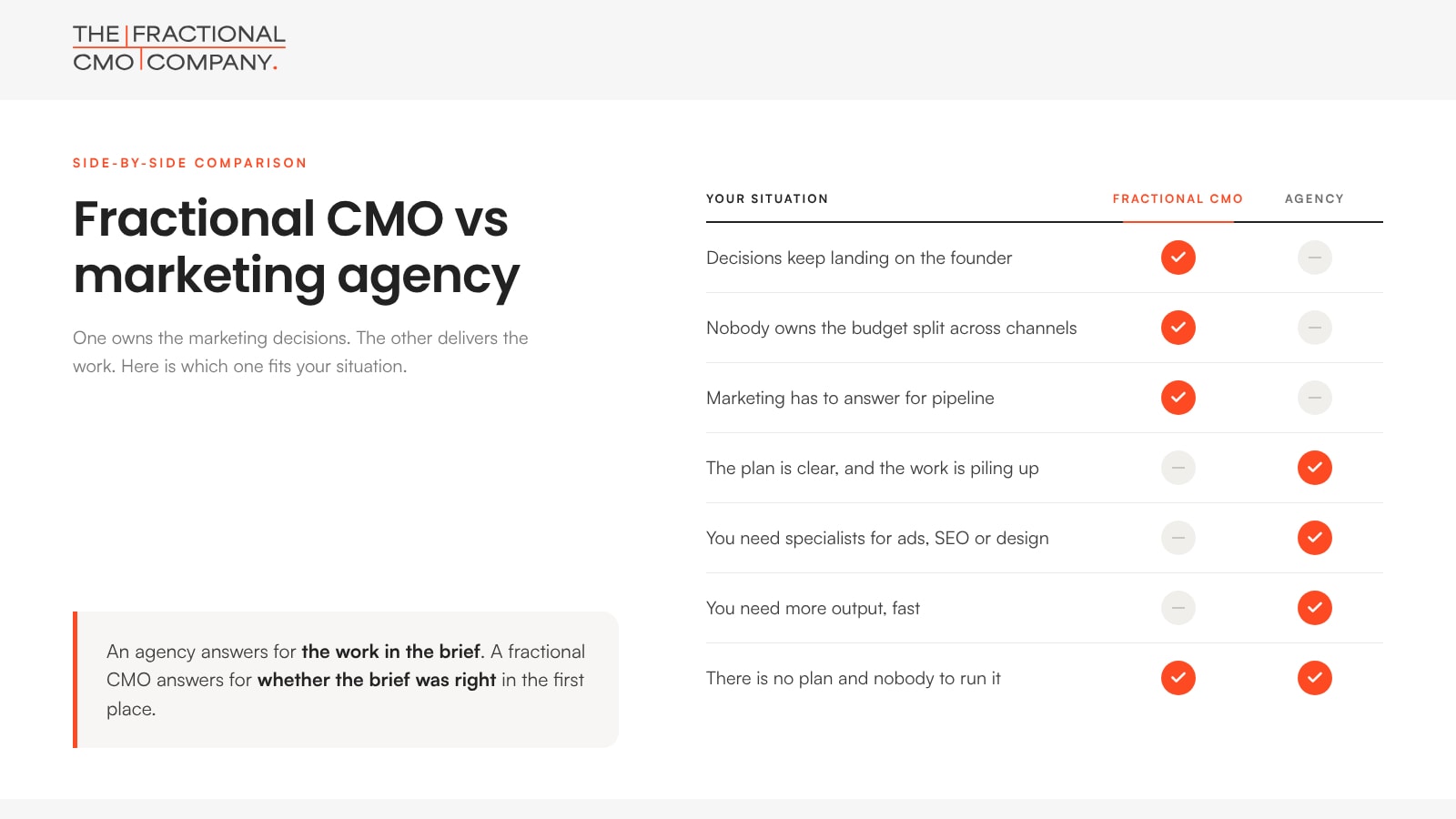
The easiest way to tell them apart is to ask what each one answers for. An agency answers for the work in the brief. A fractional CMO answers for whether the brief was right in the first place.
| Fractional CMO | Marketing agency | |
|---|---|---|
| What you buy | Senior judgment and ownership | Specialist capacity and output |
| What it owns | Positioning, priorities, budget split, measurement | Delivery inside the agreed scope |
| Time | A few days a month, ongoing | Scales with the work you buy |
| Accountable for | Marketing's contribution to pipeline | Agreed deliverables and channel metrics |
| Manages other partners | Yes | No/ Rarely |
| Best when | Decisions keep landing on the founder | Direction is clear and delivery is stretched |
Some agencies offer senior leadership. Some fractional CMOs bring an execution team. Read the proposal before assigning either a job it has not agreed to do.
For more on the role itself, see our complete guide to fractional CMOs, or watch this two-minute episode of The Fractional Take on how fractional leadership works across marketing, tech and finance.
Most founders ask this once growth has slowed, but slow growth on its own will not tell you which hire to make. First you need to know whether you have a strategy problem or an execution problem.
Two questions usually settle it: who makes the hard marketing calls today, and do you have people to do the work?
If someone on your team already makes the hard calls and the work keeps piling up, hire an agency or a specialist. You know who the buyer is, you have seen a channel work, and someone inside can write a sharp brief. Another senior leader would mostly add meetings, when what you need is more hands.
If your team can do the work but every decision comes back to the founder, hire a fractional CMO. Your marketers are capable, yet nobody can settle a disagreement between the SEO plan and the paid plan, or move budget from one to the other. That is a leadership gap. A fractional CMO can close it, as long as you are ready to hand those decisions over.
If you have neither, hire both, one after the other. Bring in the leader first and let them scope the agency work. Companies that sign two retainers on the same day often end up with a strategy deck and a content calendar that have never met.
And if you have both and growth is still stuck, look at the offer and the handoff to sales before you change vendors. Swapping agencies at this point is a bit like changing drivers when the car has a flat tire.
One more case: if you are still working out what customers will pay for, keep it small. You need someone who can talk to buyers and run quick tests. A big production engine at this stage mostly produces content about a product that is about to change. A senior advisor with nobody to run the tests has the opposite problem, ending up with a good plan and very little evidence.
Answer the two questions below to see where you land.
There is no revenue number or company size at which one model becomes the right one. The decisions you are stuck on matter more than the stage on your pitch deck.
As much as you agree to upfront, and it helps to be specific. A fractional CMO cannot own choices the founder keeps making. An agency cannot keep work moving if nobody owns the approvals. So before work starts, agree who decides what and who signs it off.
Here is a starting point for a company using a fractional CMO alongside an agency:
| Decision | Who decides | Who signs off |
|---|---|---|
| Goals and total marketing budget | CEO or leadership team | Budget owner |
| Target buyers and positioning | Marketing lead, with sales input | Named leadership approver |
| Channel mix and budget shifts | Marketing lead, within an agreed limit | Budget owner, above that limit |
| Campaigns and content | Marketing lead sets the brief; agency or team delivers | Named marketing approver (legal where needed) |
| Performance review | Marketing lead, with sales and finance | Leadership, for big changes |
The sign-off column has one rule: it should not quietly turn into "the founder, for everything." Switch the view below to see what happens when nobody agrees on approvals in advance.
Fill this in during the first week, even if it takes an argument or two. It is a lot easier to settle who approves what in one meeting than across fifty WhatsApp messages.
Managing your agency is part of the job. Once a fractional CMO comes in, your agencies and freelancers work to their brief, the same way they would with a full-time CMO.
Replacing the agency is a different conversation. Your fractional CMO is there to lead marketing. If they also have to run your ads and write your blogs, you end up paying senior rates for work your agency already does well. So unless someone else can take that work on, keep the agency.
One of the first things a good fractional CMO does is read the briefs your agencies were given. Quite often, the paid-media agency is doing exactly what it was asked to do, which is bring in more leads. Sales just wanted better ones. Fix the brief, and the same agency usually starts looking a lot better.
Firms that offer both leadership and execution, like ours, should be comfortable telling you when your current agency is the right fit. If you are not sure, ask.
Some do, and some do not, so check the proposal. Every fractional CMO sets direction and owns the marketing decisions. How hands-on they get after that varies. One might build campaigns alongside your team, while another leads your team, freelancers and agencies and stays out of day-to-day production.
Ask them what they will do themselves and what they will oversee. If your team already does good work, say so early, because many founders only need senior direction.
As for cost, US market guides put fractional CMO retainers at roughly $5k to $15k a month. A multi-channel agency usually charges $7k to $25k or more, and that is before any ad spend. Those two numbers are hard to compare, though, because one pays for someone to lead your marketing and the other pays for people to do the work. Look at the full monthly cost of getting marketing done instead, which usually covers:
the fractional CMO's fee
whoever does the work, whether that is your team, freelancers or an agency
ad spend and tools
one-time setup, such as moving ad accounts or fixing tracking
As you add it up, look for anything you are paying for twice, like two partners each sending their own version of the monthly report. And if one proposal is much cheaper, ask what it leaves for your team to do and whether anyone there has the time.
Think back to that Tuesday. Everyone on the founder's list was waiting for the same thing, which was someone to make a call. If your weeks look like that, you are short on leadership, and that is the gap a fractional CMO fills. If the calls are already being made and the work simply cannot keep up, an agency will get you moving faster. Plenty of companies end up needing both, just at different moments.
If you are still unsure where you sit, walk us through a normal week of your marketing. We will give you a straight answer on whether a fractional CMO makes sense for you right now, even if that answer is "not yet." Let's talk.
Yes, as long as there is a plan for who does the work. That could be freelancers, an agency, a new hire or hands-on work written into the fractional CMO's scope. Agree this upfront and budget for it, because leadership on its own does not produce campaigns.
Yes, and it is a sensible way to begin. Agree on the problem, what gets delivered, which decisions the fractional CMO can make and a review date. Then decide together whether to continue, change the scope or hand over. A short diagnostic tells you what to do. Someone still has to do it afterwards.
For the leadership itself, usually yes. You pay for the senior time you use, without a full salary, benefits or a hiring process that can take months. Our complete guide to fractional CMOs covers how the two compare.
They can own marketing's contribution to pipeline and revenue. They cannot single-handedly control sales follow-up, pricing or customer retention, so revenue targets work best when your sales and product leads share them.
October 22, 2026
How relevant and useful is this article for you?