
Podcast
AI and Brand Trust: What Marketers Are Missing in 2026
July 07, 2026
September 22, 2026
All Blogs Generative Engine Optimization: How B2B Brands Win in AI Search
Twenty years ago, meeting a new buyer was simple. They typed a problem into Google, scanned the first page, and shortlisted three or four vendors. Your job was to be on that page.
Today, a founder opens ChatGPT or Perplexity and asks, "Who are the top three vendors for what I need?" The reply is one answer. A considered, confident, complete answer. No page two. No ten blue links. No scrolling.
If your company is not in that answer, you were not in that deal. You will never know the meeting you did not get.
That is the shift this post is about, and it is bigger than an SEO tactic. Discovery itself has moved, and most B2B marketing playbooks have not.
Search trained an entire generation of buyers to do their own legwork. Type, scan, click, compare, repeat. Marketing's job was to win the click.
AI answer engines have collapsed that journey into a single conversation. The buyer describes their situation in plain language, and the assistant does the scanning, comparing, and shortlisting for them. By the time someone lands on your website today, an AI may already have decided whether you belong on the shortlist.
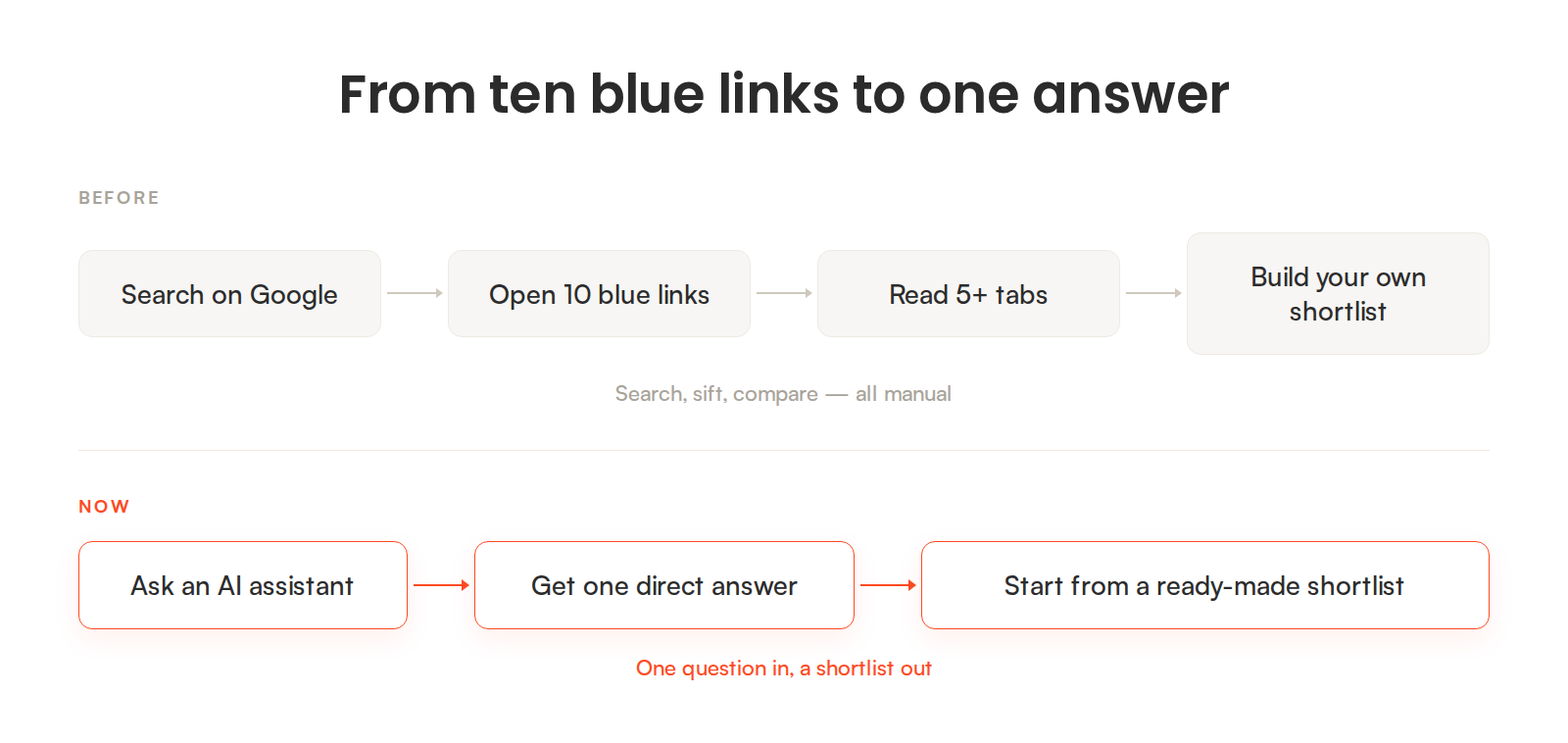
You can see this in your own numbers. Many B2B teams are noticing a quiet pattern: organic traffic softening while branded search and direct traffic hold or grow. Buyers are still researching. They are just doing the early research somewhere your analytics cannot see, inside a chat window. It is the dark funnel all over again, except this time the room where decisions happen belongs to an AI.
And the habit is sticky. Once a buyer gets a useful shortlist from a single question, going back to ten open tabs and a page of links starts to feel like work. That is the behavior your marketing now has to earn its way into.
What to pull: your organic traffic trend over the last four quarters, your branded vs. non-branded search split, and the share of conversions tagged "direct" or unattributed.
None of this means SEO is dead. It means SEO is no longer the whole job.
Classic SEO optimizes for a crawler that indexes pages and an algorithm that ranks links. Answer engines work differently. They read, synthesize, and then decide which handful of brands deserve to be named in a single response. You are no longer competing for position four versus position seven. You are competing to be mentioned at all.
That changes what "good" looks like:
Ranking is not the same as being cited. You can hold a top-three Google position and still be absent from the AI answer for the same question.
Traffic is not the same as visibility. A buyer can learn your name, your positioning, and your competitors' names from an AI without ever visiting your site.
Keywords are not the same as questions. Buyers talk to AI in full, specific, situational questions: "What is the best ABM agency for a Series B SaaS company selling into healthcare?" Content written for a keyword rarely answers that.
Here is a quick test you can run this afternoon. Open ChatGPT, Perplexity, Claude and Gemini, then ask each tool ten questions a buyer might use to build a shortlist before speaking to sales. Adapt the wording to your category, industry and growth stage:
Count how many times your company appears, how often competitors appear, and whether the information about you is accurate. Save the answers and screenshots so you can repeat the same test monthly.
These systems are not mysterious. They recommend what they can verify. Brands that get cited consistently tend to share a few traits, and none of them require a big budget.
Consistent facts everywhere. Your website, LinkedIn, Crunchbase, review sites, and press mentions should all describe the same company in the same terms. Contradictions make you harder to trust and easier to skip.
A footprint beyond your own site. AI answers lean heavily on third-party sources: reviews, comparison articles, podcasts, analyst notes, community threads.
Content that answers questions directly. Clear definitions, honest comparison pages, real FAQs, and plain-language explanations of who you serve and why. The clearer your answer, the easier you are to quote.
Original substance. Proprietary data, a sharp point of view, named frameworks. AI engines reward material that adds something to the conversation rather than repeating it.
Technical hygiene. Crawlable pages, structured data, fast load times. The basics now serve two masters: the search crawler and the AI retriever.
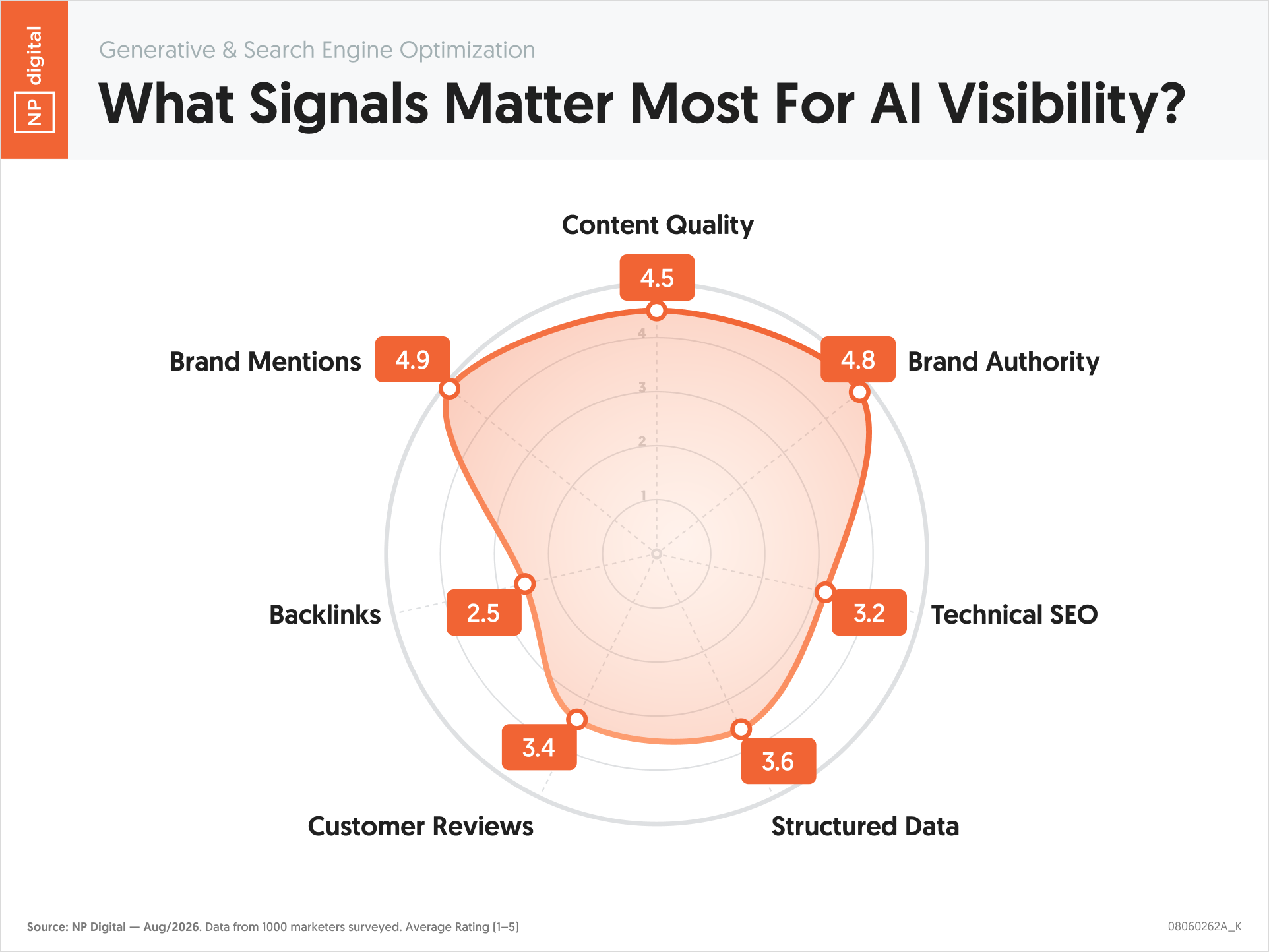
Source: https://neilpatel.com/marketing-stats/signals-matter-most-ai-visibility-2/
Notice what is missing from that list: gaming the system. There is no keyword-stuffing equivalent here, because the engine is not counting keywords. It is assembling a picture of whether you are a credible answer.
What to fix: brand description consistency across your top five external profiles, one comparison or alternatives page, and one piece of content built on data only you have.
Generative engine optimization (GEO) sounds like a new department. It is not. It is a set of habits that sit on top of the marketing you already run. Five moves will take you most of the way:
Audit your AI visibility. Run the ten-question test monthly across the major AI tools. Track which competitors get cited, what the engines say about you, and where the facts are wrong.
Rewrite key pages around buyer questions. Take your top five pages and rebuild each around one real question a buyer asks. Answer it in the first paragraph, plainly, then go deeper.
Publish something only you can say. One original data point, one counterintuitive finding from your own pipeline, one strong opinion with evidence. This is what earns citations and links.
Earn third-party mentions deliberately. Podcasts, guest posts, analyst briefings, industry associations, review platforms. Every credible external mention is raw material for the next AI answer.
Measure AI citations as a KPI. Put AI mentions, branded search volume, and direct traffic next to your rankings in the monthly report. What gets measured gets resourced.
What to do: pick moves one and two this month. They cost nothing but attention, and they tell you how much of move three and four you actually need.
Here is where most companies get stuck. Look at the five moves again. SEO owns the pages. PR owns the mentions. Content owns the original substance. Brand owns the consistent facts. Events and analyst relations own part of the footprint.
AI visibility cuts across all of them, which means no single channel lead owns it. When everyone owns a piece, nobody owns the outcome.
This is precisely the kind of problem a fractional CMO exists to solve. Not by adding another tool or another agency, but by holding the strategy end to end: deciding which questions the brand must win, aligning SEO, content, PR, and brand around those questions, and keeping the measurement honest. The companies that treat AI discovery as a leadership problem will compound quietly while competitors keep polishing their meta tags.
AI discovery is not a single fix. It is strategy, content, PR, and brand moving together, which is exactly the work a fractional CMO coordinates. If you want an honest read on what your buyers are asking AI about you, let's talk.
Generative engine optimization is the practice of making your brand visible, accurately described, and citable inside AI-generated answers from tools like ChatGPT, Perplexity, Gemini, and Copilot. Where SEO optimizes for ranked links, GEO optimizes for being named and quoted in a synthesized answer. It draws on content quality, third-party credibility, brand consistency, and technical hygiene rather than keyword targeting alone.
No. SEO still matters, because AI answer engines draw heavily on the same indexed, crawlable web that search engines use, and strong organic foundations make you easier to retrieve and cite. What has changed is that SEO alone no longer guarantees visibility. A page can rank well and still be absent from the AI answer for the same question, so SEO needs to be paired with GEO practices like question-led content, third-party mentions, and brand consistency.
There is no fixed timeline, and any agency promising one should be questioned. In practice, technical fixes and content rewrites can show up within weeks, while the slower variables, third-party citations, original research, and brand authority, build over quarters. The right approach is to run a monthly audit of the buyer questions that matter and track whether your presence and accuracy improve.
Yes, and in some ways more easily than in classic search. AI answer engines favor clear, specific, credible answers over domain size, so a niche player with sharp positioning, original data, and consistent third-party mentions can out-cite a larger competitor with generic content. Specificity is the small company's advantage: own one buyer question completely rather than chasing fifty.
September 22, 2026
How relevant and useful is this article for you?