Blog
Strategy Rarely Fails in the Boardroom, it Fails in the Handoffs.
November 19, 2026

Anjali Gupta
Founder & Fractional CMO
November 20, 2026
All Blogs Small by Design: Why the Future Belongs to Tiny Teams
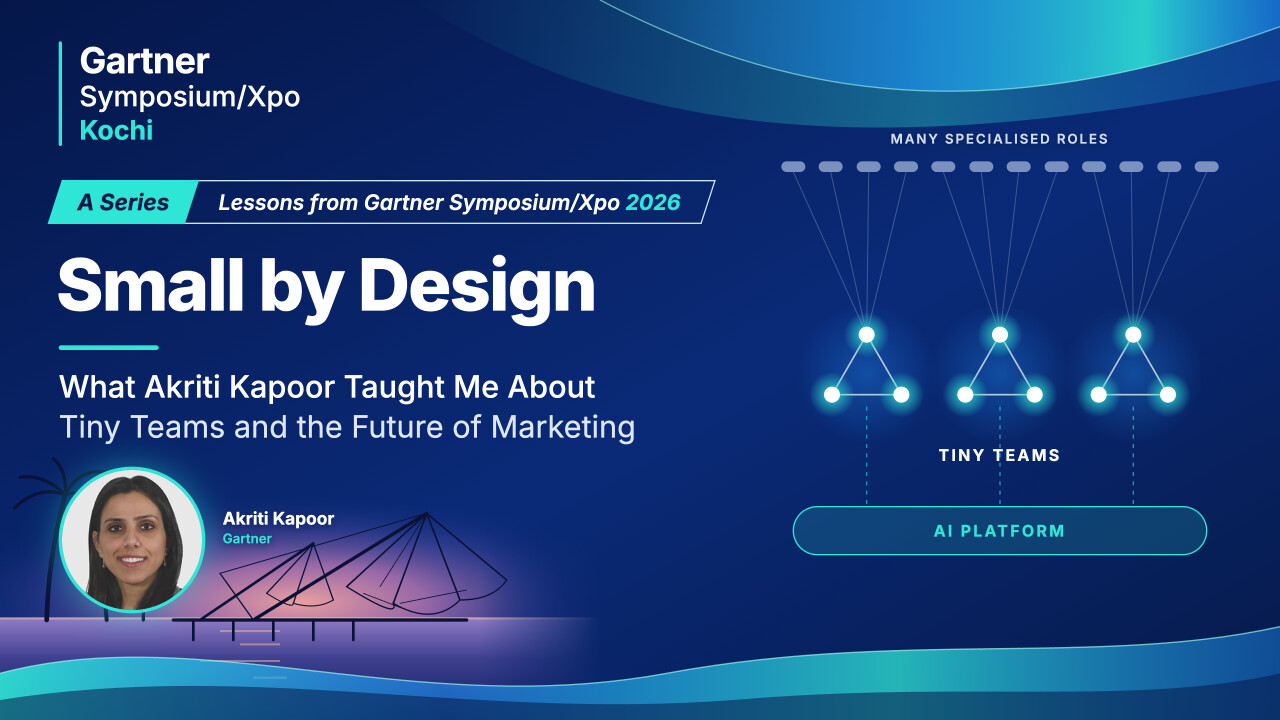
Why a Gartner session on AI-enabled tiny teams felt like a session about my own working life, and what it means for every role in marketing. Part 3 of my series, Lessons from Gartner Symposium/Xpo 2026.
I did not wander into Akriti Kapoor’s session at Gartner Symposium/Xpo in Kochi by accident. I chose it deliberately, because my working life is, quite literally, a life lived in a tiny team. The Fractional CMO Company is small by design, and in any given week I find myself moving between roles that a large enterprise would spread across an entire floor: brand strategist on Monday, copywriter and ghostwriter on Tuesday, event host and moderator on Wednesday, podcast host on Thursday, and on Friday the analyst trying to make sense of what all of it achieved. So when a Gartner analyst stood up to explain how AI enables smaller teams to deliver outsized outcomes, I was listening less as an observer and more as someone checking whether the way I already work has a future.
The reassuring answer is that it does, with one important condition. In her opening minutes Akriti drew a distinction that I wish every leader would internalise. She was not talking about teams that are small because budgets were cut or headcount was reduced; she was talking about teams that are deliberately small and far more capable, because AI allows each person on them to do a great deal more. The first is a cost story and the second is a capability story, and so much of the anxiety about AI at work comes from confusing the two.
The idea comes from the startup world, where a handful of AI-native companies have reached extraordinary levels of recurring revenue with remarkably small teams, and where revenue per employee has quietly become the metric that matters. Gartner’s contribution is to translate that principle for the enterprise. Its definition, framed around software engineering, is a team of perhaps three to five people, enhanced by AI and fully accountable for the outcome of what it builds. The team is small, it is powered by AI, and it owns an outcome rather than a list of assigned tasks.
That last element is the one that matters most, and it is where I think marketing has the most to learn. Akriti put it memorably: a traditional team doing the same work in the same way with fewer people is not a tiny team at all; it is just a stressed team. Every marketer reading this will recognise the stressed team. It is the department that lost two people in the last budget cycle and was told to keep delivering the same calendar of campaigns, events and content, with the same approval chains and the same agency handoffs. That is not transformation. It is attrition with a new name.
Nor, she was careful to stress, is this an argument for cutting headcount. Her illustration was that three teams of eight to ten people might become six teams of three or four people working alongside AI agents: twice as many teams, pursuing twice as many opportunities, each with far clearer ownership.
The first of Akriti’s three prerequisites is role compression, and this is where her session most directly described my own world. For years, she argued, organisations have specialised, creating ever more distinct roles; specialisation has its value, but every boundary between roles creates a handoff, and every handoff creates delay. AI is changing the economics of specialisation by allowing one person to own a much broader span of work, so the pendulum is swinging towards fewer job titles with more capability per person.
Marketing is perhaps the most specialised function in the modern enterprise. A typical team includes a brand manager, a content writer, a designer, a social media manager, a performance marketer, an SEO specialist, an events manager, a public relations lead, a marketing operations and MarTech owner, an analyst, someone running sales enablement, someone running partner and alliance marketing, and someone managing the agencies who do much of the actual production. A single campaign can pass through eight pairs of hands before it reaches a customer.
Role compression suggests that this will consolidate into a smaller number of broader, more capable roles. I can already see four of them emerging in my own work and in my clients’ teams. There is the content-to-campaign marketer, who can take a brief from strategy through copy, visual and distribution with AI as a creative partner, collapsing what used to be four handoffs into a single afternoon. There is the growth marketer, who brings performance marketing, analytics and marketing operations together and can build, measure and optimise a programme without waiting on three other teams. There is the brand and narrative lead, who holds positioning, public relations, executive communications and thought leadership as one continuous story rather than four separate workstreams. And there is the field and ecosystem marketer, who combines events, partner marketing and sales enablement, because in B2B technology those three are really one job: helping customers and partners have better conversations.
Akriti noted that some roles in software engineering are fading altogether, observing that agile is becoming something you do rather than something you are. Marketing has its equivalents. Traffic management, manual campaign reporting and much of production coordination are increasingly things that good marketers and good tools simply do, rather than jobs in their own right.
How do we prepare people for this? Her answer was flexible career paths that let people move across adjacent disciplines rather than climb narrow vertical ladders, and role partnerships in which people learn new skills by working alongside each other. In marketing, that might mean pairing a content writer with a performance marketer so that each learns how the other thinks, or bringing a designer into customer conversations so that the work is shaped by real needs rather than a brief written three steps removed. CBRE offered a compelling example from engineering: it moved to smaller teams without reducing headcount, and designed those teams around skills rather than job titles. That is exactly how I build a team for each client engagement. I begin by asking which skills the work needs, not which titles I need to fill.
The second prerequisite is the forward-deployed engineer, a role popularised by Palantir and other technology vendors: a hands-on technical specialist who works side by side with domain experts to build a solution quickly. Enterprises are now adapting the idea internally, pairing a technical expert with someone from sales, finance or legal, so that one brings the know-how to build and the other brings the context about what must be built. One investment bank described the formula as pairing a deeply technical engineer with a deeply non-technical domain expert.
I smiled at this, because a fractional CMO is, in a very real sense, a forward-deployed marketer. My work is to embed myself inside a client’s business, sit beside the founders, the sellers and the product people who carry the deep context, and build the narrative, the campaigns and the go-to-market engine with them, rather than at arm’s length from them. Within larger marketing teams, the same principle applies: the most effective marketers I know are the ones who spend real time with sales, with product and with partners, and who translate that context into work the customer actually responds to.
Akriti’s caution here is worth heeding. The role requires a rare combination of craft, business acumen, empathy and the ability to learn quickly; one CIO estimated that fewer than five per cent of her developers could do it. The same is true in marketing. Not every marketer will thrive embedded in the business, and that capacity should be reserved for the initiatives where context matters most.
The third prerequisite, and in many ways the backbone of the whole model, is the platform. Tiny teams cannot scale without robust platforms providing curated AI tools, reusable components and agent skills, shared context, paved roads with governance built in, and safe sandboxes for experimentation. The aim, as Akriti put it, is to make the right thing the easy thing. And, counter-intuitively, as product teams become smaller, platform teams may need to become larger.
For marketing, the platform is the brand system and everything around it: the positioning and messaging house, brand guidelines, approved claims, content libraries, customer and campaign data, a well-run MarTech stack, and increasingly the curated prompts and AI agents that carry the brand’s voice. When those are packaged as a paved road, a team of three can sound like a team of thirty and still stay on brand, on message and on the right side of compliance. When they are missing, a small team spends half its time reinventing basics and the other half fixing inconsistencies. In my experience, investing in the marketing platform is the single most underrated decision a CMO can make, and it is the decision that makes a tiny team possible at all.
Akriti was refreshingly candid about the risks, and each of them has a marketing equivalent I have lived through. Reskilling is substantial, and broader roles need real investment in learning, not just a new job description. Overload is a constant danger, because marketers are already stretched and AI can just as easily become a reason to pile on more work as a reason to work differently; that path leads to burnout, not productivity. And smaller teams create more single points of failure, which every marketing leader knows from the day the one person who truly understood the CRM or the brand guidelines moved on. Her suggestion of apprenticeship pairings, in which senior and junior colleagues work together to transfer knowledge and build in some slack, is as wise in marketing as it is in engineering.
Akriti’s action plan translates easily. In the immediate term, assess your team’s readiness for AI, identify where roles could sensibly be compressed, and design the upskilling to support it. Over the next ninety days, identify the few people who combine craft with deep customer and business empathy for embedded, forward-deployed roles, and strengthen your marketing platform so that it absorbs complexity on everyone else’s behalf. Over the next twelve months, build career paths that bring creative, analytical and commercial skills together, and pilot small, AI-native marketing teams designed around skills rather than titles.
Her closing thought is the one I would underline twice, because it describes the kind of team I have chosen to build. The winning model is not to shrink teams and ask everyone to work faster; it is to build smaller teams of versatile people who combine craft and domain expertise, and to support them with platforms that make their work easier.
November 20, 2026
How relevant and useful is this article for you?