Blog
Small by Design: Why the Future Belongs to Tiny Teams
November 20, 2026

Anjali Gupta
Founder & Fractional CMO
November 19, 2026
All Blogs Strategy Rarely Fails in the Boardroom, it Fails in the Handoffs.
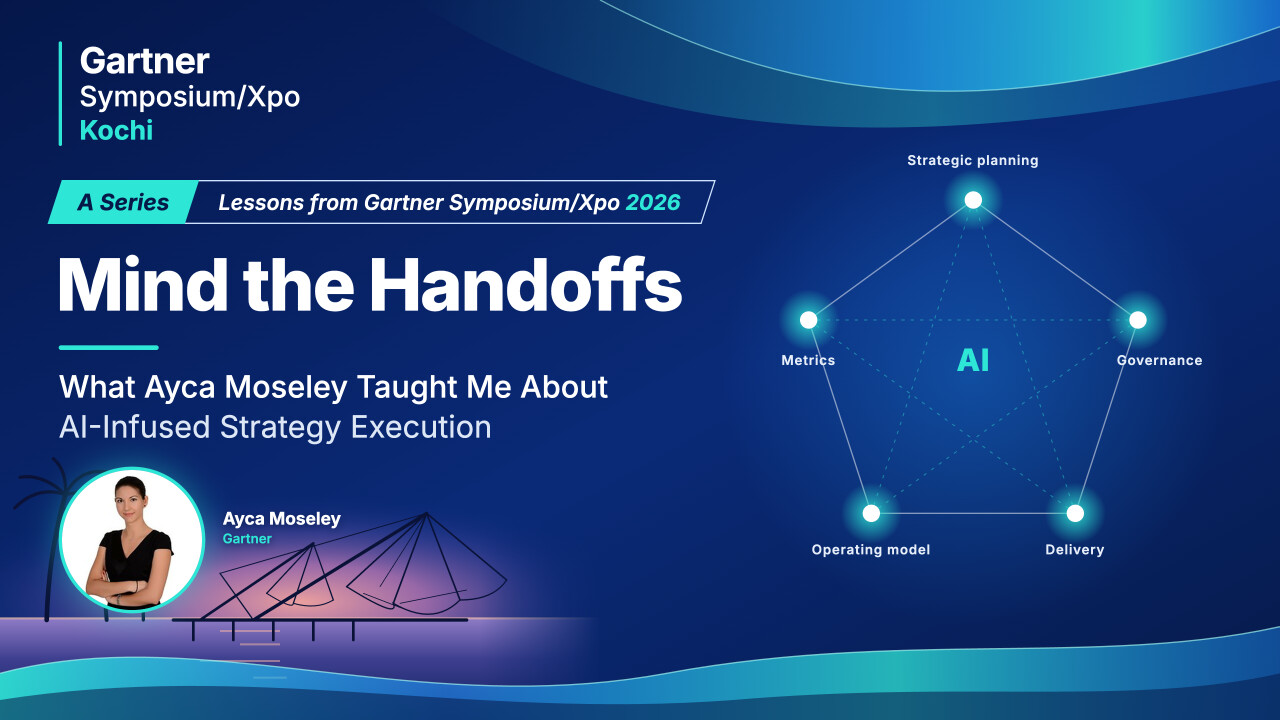
Reflections on Ayca Moseley’s Gartner session on AI-infused strategy execution, and why it matters so much to those of us who lead marketing
Some conference sessions rearrange the furniture in your head very rapidly. Ayca Moseley’s session at the Gartner IT Symposium/Xpo in Kochi this week, AI-Infused Strategy Execution: Unlocking Sustainable Competitive Advantage, did that for me, and I have been turning it over and over ever since. Ayca, who covers strategy at Gartner all the way from planning through to execution, opened with a truth that anyone who has lived through enough annual planning cycles will recognise immediately: for decades, leaders have poured extraordinary energy into crafting brilliant strategies, only to watch them stagnate, if not fail....somewhere between the boardroom and the market.
What made the session so interesting to me is that my job (And my interest) sits squarely to solve that problem. Across twenty-eight years in B2B technology marketing, and now in my work as a fractional CMO and business strategist, the hardest problems I encounter are rarely about the quality of the strategy itself. They are about what happens to that strategy as it travels through an organisation, through planning calendars, approval chains, partner handoffs, review meetings and reporting cycles, and how much of its intent, urgency and intelligence leaks away along the way.
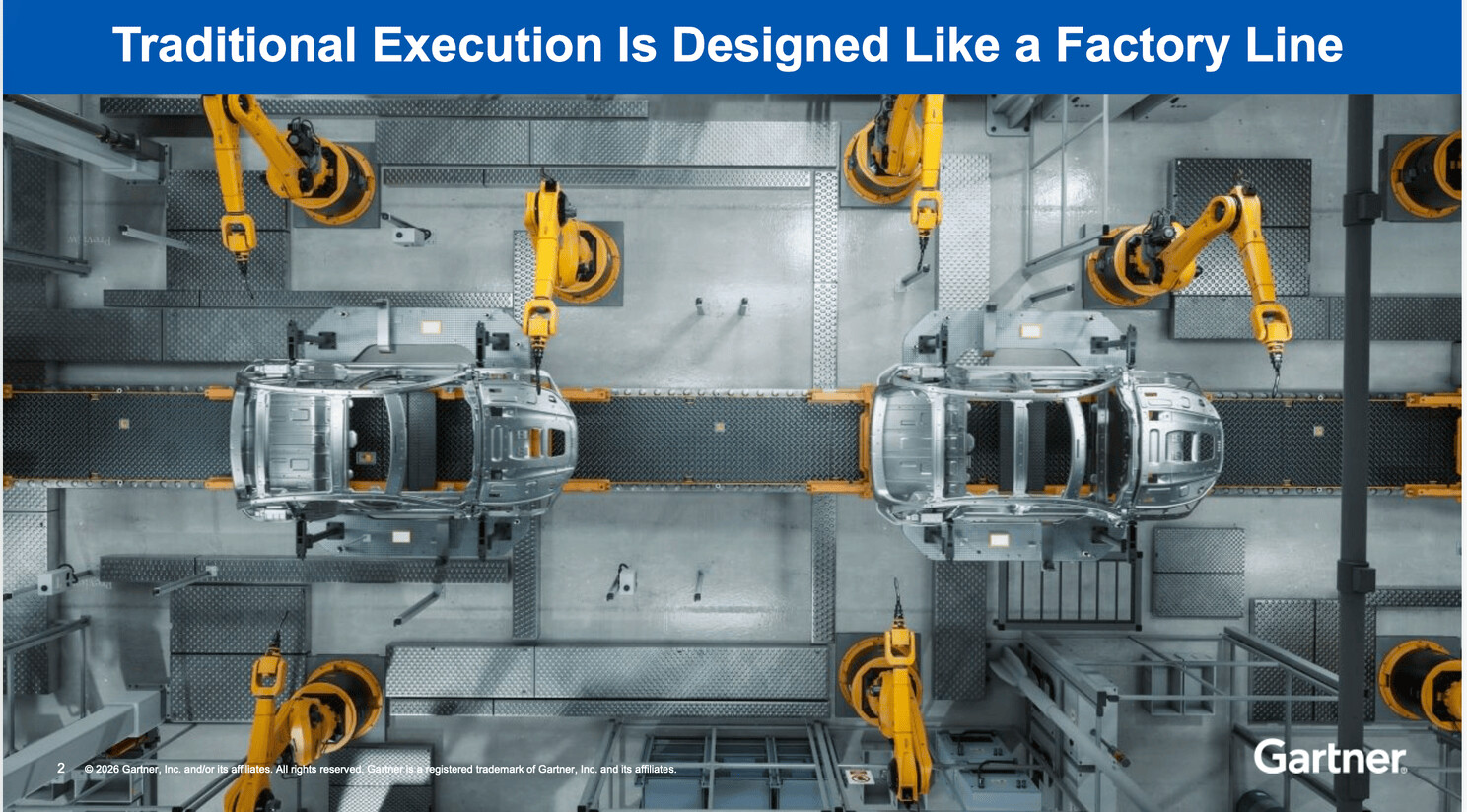
Ayca’s central image was simple and quietly devastating (See above - from Gartner deck). Traditional execution, she argued, is designed like a factory line. Strategic planning sets the direction, delivery carries it out, governance inspects it, metrics report on it after the fact, and the operating model tries to coordinate the whole. Each stage hands off to the next, and at every handoff we pause, lose a little momentum and lose (more than) a little signal. That design works tolerably well when conditions are stable, but very few of us are operating in stable conditions any more, and by the time new information has worked its way through meetings, reports and approval queues, the moment to act on it has often passed.
Real organisations, she suggested, behave far more like neural networks than assembly lines, and the strength of the connections between the parts determines how quickly the whole can respond to change. If that is how organisations actually work, then that is how strategy execution should be designed: as a connected network of five nodes, namely strategic planning, governance, delivery, the operating model and metrics, continuously exchanging signals and feedback rather than passing a baton down the line.
The prescription follows naturally from the metaphor. A network performs well when its nodes are strong and its connections are clean, so improving execution means doing two things together: infusing AI into each node to raise its speed and quality, and deliberately improving the quality of the connections between them.
What I appreciated most was how concretely Ayca translated each node into a shift from an old pattern to a new one.
In strategic planning, the move is from static annual plans to continuous sensing and simulation. AI-enabled competitive and market intelligence, continuous forecasting, scenario simulation and dynamic resource allocation turn planning from an annual event into an ongoing discipline. Her example of Wasabi AI, the US cloud storage company, was a good one: an internal agent that draws signals from CRM, support, engineering and external analyst sources, weighs each according to the strength of its evidence, scores the resulting themes against what the team can realistically deliver, and writes prioritised recommendations straight back into the product team’s working tools alongside a weekly strategy brief. Her point was that while Wasabi is digital-native, the technology now exists for almost any organisation to plan this way; what is usually missing is the investment in the underlying data and connections.
In governance, the shift is from inspection tollgates to auto-enforced guardrails. Rather than steering committees, approval queues and policy documents that nobody remembers, controls are embedded directly into workflows through policy as code, continuous risk monitoring, regulatory intelligence and automatic audit trails, so that teams can move faster precisely because compliance is travelling alongside them instead of waiting at the gate. Her data-governance example rang true: we publish careful policies and then expect busy people to memorise them while trying to get their actual work done.
In delivery, the shift is from key-person bottlenecks to scaled knowledge and expertise. So much execution risk sits inside the heads of a handful of senior experts or external consultants, and AI now allows organisations to capture that knowledge, with the consent and participation of those experts, and make it available far more widely. BDO’s use of a knowledge graph to encode the decision logic of a small group of tax specialists, collapsing R&D tax assessments from hours to seconds while freeing those specialists for higher-value client work, was a vivid illustration of what becomes possible.
In the operating model, the shift is from hierarchies and decision layers to fusion teams and autonomy, and Ayca was careful to stress that this is a design choice rather than a technology problem. Not every decision belongs at the edge, so the operating model has to be explicit about which decisions stay at the centre and which can be devolved. Kubota Corporation, operating across more than 120 countries, did exactly that, using a clear scoring approach to assign decision rights according to risk, impact and business context, so that regional teams gained autonomy where they understood the market best while headquarters retained oversight where enterprise-wide risk demanded it.
And in metrics, the shift is from post-mortem reporting to early warning and intervention: execution-monitoring agents that establish baselines, watch leading indicators across customers, operations and financials, and raise a flag while there is still time to act, provided of course that we have first done the unglamorous work of defining and cascading our objectives and connecting the data behind them.
Had the session stopped there, it would have been a very good talk about AI use cases. What elevated it, for me, was the second half, which was about the spaces between the nodes, and which in places required no technology at all.
The first practice was improving signal quality. Ayca asked the room how many times we have sat through an hour-long portfolio review, listening to pages of completed activities and planned next steps, and walked out still unsure where the real risks lay or what we were expected to do about them. That is information overload masquerading as transparency. Each node should send interpreted, prioritised and actionable signals: planning should communicate priorities clearly, delivery should surface blockers and dependencies rather than thirty-page status reports, governance should communicate risks and guardrails, and metrics should speak only to what genuinely needs attention. AI assistants can help with the filtering, but she was emphatic that it begins as a cultural change, and that the change has to be led from the top.
The second was reducing friction by designing governance, delivery and the operating model as one system. Her example is one I have seen play out in more organisations than I could count. Leadership announces that it wants faster decisions and greater team accountability, but governance never clarifies which decisions teams are actually permitted to make, and the delivery process still contains every management approval it always did, so people keep escalating and waiting exactly as before. Her observation that execution can often be accelerated significantly without changing strategy, people or technology, simply by aligning decision rights and standard operating procedures with the behaviour you say you want, is perhaps the most immediately actionable idea I took away.
The third was creating continuous feedback loops between strategic planning, delivery and metrics, and here investment in technology genuinely matters: strategic portfolio management platforms that link objectives, projects, people and budgets, execution-monitoring agents, and, for the more ambitious, a digital twin of the organisation. She brought it to life with a single imagined working day. An agent flags over the morning coffee that a flagship initiative is not delivering the engagement it promised; by mid-morning, market intelligence shows that a competitor has moved; before lunch, a portfolio analysis surfaces higher-value alternatives already sitting in the backlog; by early afternoon, leaders have redirected funding and talent; and by the end of the day, plans and resource allocations have been updated. Detection, evaluation and course correction, all within the same working day.
Ayca closed with an idea I have been repeating to colleagues ever since: organisations once competed on scale, then on efficiency, and increasingly they compete on adaptability, on the ability to sense change, re-prioritise and redirect execution quickly.
Listening as a marketer, I could not help mapping her five nodes onto the function I have spent my career in, because marketing is very often the purest example of the factory line she described. We build an annual plan in the last quarter of the year and then defend it for twelve months, whatever the market does. Creative and brand approvals move through tollgates that add days without adding much assurance. Critical knowledge about our partners, our customers and what has actually worked tends to live in the heads of two or three people. And our reporting, for all its dashboards, too often tells us what happened last quarter rather than what we should change this week.
The same is true of the alliance and ecosystem work I do. A partnership is by definition a network rather than a line, with two organisations, their sellers, their solution teams and their shared customers all needing to exchange clean signals quickly. Most partnerships that disappoint do not fail for want of strategy; they fail because the connections are weak, through slow handoffs, noisy reporting and unclear decision rights about who can commit to what, and because nobody designed the governance, the delivery and the operating model together.
That is why I found the session so valuable. It gives leaders a diagnostic question that is both simple and searching: when execution stalls, is the problem inside a node, or in the connection between nodes? Very often, I suspect, it is the latter, and very often the fix is far less expensive or time consuming than we imagine.
Her closing counsel is the part I would underline twice: start small, strengthen one node, improve one connection, and build from there.
November 19, 2026
How relevant and useful is this article for you?