Blog
Why Most B2B Companies Confuse Marketing Activity with Marketing Strategy
April 02, 2026
April 22, 2026
All Blogs What Is a Fractional CMO? The Complete Guide for B2B Companies (2026)
Every B2B founder starts as an accidental CMO. The product ships, the first customers close, and someone asks: who's handling marketing? The answer is almost always the founder.
That works until the company grows faster than one person can carry it. The team gets hired, campaigns go live, and the founder is still the one making every marketing call because no one else has the context or authority to. What the business needs at that point is someone who has both.
A fractional CMO is that person. A senior marketing executive who comes in part-time, owns the strategy, manages the team, and is accountable for the same outcomes a full-time hire would be, without the cost or the lengthy ramp-up.
The short answer: everything a full-time CMO does, minus the grueling executive search and the equity negotiations.
They own your marketing strategy, lead your team, and are accountable for the same revenue outcomes as a full-time hire. What makes the model different is its perspective. Someone who has worked across multiple companies and industries has seen your growth problem before, usually more than once, and knows which solutions actually hold under pressure.
What they actually do depends on where your company is in its journey:
Early stage: Defining your positioning and ICP, building your brand narrative from the ground up, and getting the demand generation infrastructure in place to back it.
Growth stage: Finding the leak in a budget that looks busy but is not producing pipeline, and fixing the strategy, and often the brand clarity, underneath it.
Pre-fundraise: Making sure your market narrative holds up when a room full of investors starts asking hard questions.
The work shifts as you scale, but the leadership stays constant. They do not just fill a gap. They build a system that keeps running long after they leave.
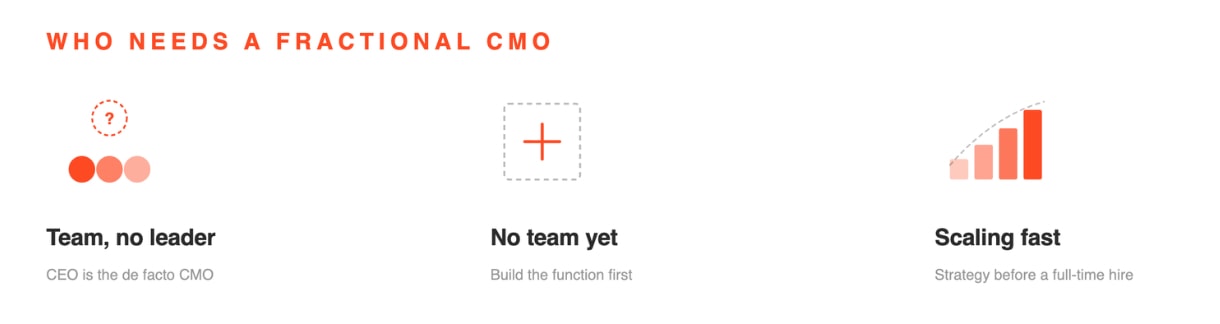
The model works best in two situations. The first is when there is an active marketing team but no one senior enough to set the direction; when the CEO is making every marketing call because no one else has the authority to, and bringing in a full-time CMO feels premature but leaving the function without leadership is quietly costing you pipeline.
The second is when there is no marketing team at all. Some companies bring one in before they hire anyone, to define the strategy, set up the function, and ensure the first hires go into a structure that actually works.
Where it does not work: when the problem is purely executional. If what the business needs is more content, more ads, more outreach volume, or simply "lead-gen," a specialist agency or a strong senior manager is the better fit.
If you're not sure which side of that line you're on, this piece on the difference between marketing activity and marketing strategy is worth reading first.
Here is how the options compare, by situation:
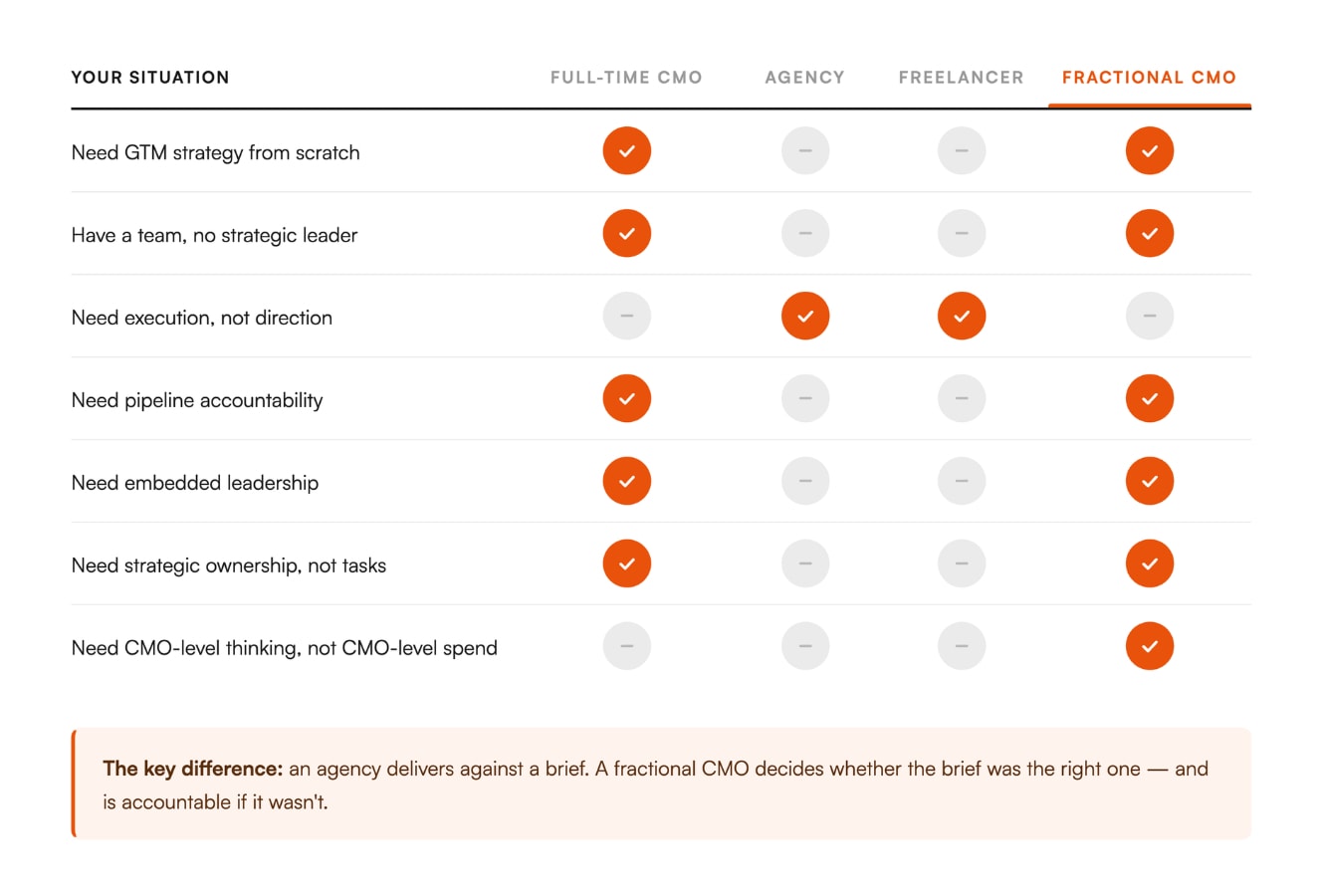
If you found yourself nodding at more than two rows in that table, it is probably worth a conversation. Let's talk.
Most people assume fractional means part-time in a loose "check in on Fridays" kind of way.
The engagement runs on structure: fixed hours, clear deliverables, and a set rhythm. The CMO is in your Slack, in your leadership meetings, reviewing your CRM data, briefing your agencies. How that looks in practice depends on the model you choose.
There are four engagement models worth understanding before you decide which one fits.
The Retainer Model: The most common. A fixed monthly fee for an agreed scope and set hours per week. The CMO attends leadership meetings, manages the marketing team or vendors, and owns the strategy. Retainers typically run six to twelve months, long enough to build something real. This is the right model when the need is ongoing leadership, not a one-time fix.
The Project Model: Best when the scope has a clear start and end. A go-to-market launch, a brand repositioning before a fundraise, or a marketing audit that turns into a ninety-day roadmap. Project engagements typically run eight to sixteen weeks. You get intensity and focus, but not continuity.
The Build-Own-Transfer model (BOT): Less common but arguably the most valuable for companies that want to build a permanent marketing function. They build the team and infrastructure from scratch: hires, processes, playbooks, tools. They own it until it runs, then hand it over to a full-time leader. BOT engagements typically span nine to twelve months, and they work because the CMO's only exit is a successful handover.
The Performance Model: Ties a portion of compensation to outcomes such as pipeline generated, MQLs delivered, or revenue influenced. It typically looks like a reduced base retainer plus a bonus against specific KPIs. Pure performance arrangements are rare. They require clean attribution infrastructure and enough brand presence to accurately measure marketing's contribution to revenue. And even then, a fractional CMO cannot control sales execution or product quality. A hybrid structure is more realistic and more honest.
The number most people focus on is the monthly retainer. The more important number is what another year without a strategy actually costs.
Fractional CMO cost varies depending on the engagement model, seniority, and scope of work. Compared to a full-time hire who comes with equity expectations and months to settle in, the fractional model gets you to results faster, at a fraction of the full-time cost.
But the real case for it is not the price; it is the leadership gap. Quarters of misallocated budget, positioning that never quite lands, a sales team and a marketing team that cannot agree on why pipeline is not moving, and no one senior enough to resolve it. If that sounds familiar, The Unified GTM Leader is worth a read.
You are not paying for their hours. You are paying for someone who has already been where you are trying to go.
Define what success looks like before you start. You do not want to reach the end of the first quarter only to realize that you and your CMO are measuring different things.
For most B2B companies, the primary focus is the marketing pipeline. You should track lead-to-opportunity conversion rates and the cost to acquire a customer (CAC) by channel. If you are using a BOT engagement (Build-Own-Transfer), success also includes how quickly your internal team becomes self-sufficient and how close you are to hiring a permanent leader.
One metric that rarely gets tracked but should: decision velocity. How quickly is the company making marketing decisions now compared to six months ago? If campaigns no longer stall waiting for approval, there is a weekly rhythm with clear ownership and no escalation required; that shift is worth more than any dashboard.
If you are still figuring out which model fits, or what success should look like for your business, that is exactly where we start. Tell us where you're stuck
A fractional CMO is a senior marketing executive who works with a company part-time or on a defined-term basis, taking full ownership of marketing strategy and outcomes.
A fractional CMO provides senior marketing leadership on a part-time or defined-term basis. They own strategy, manage teams or agency partners, make positioning decisions, and are accountable for revenue outcomes. Unlike a CMO consultant, they are embedded in the business and involved in the day-to-day decisions that actually move numbers, not just the ones that end up in a slide deck.
Fractional CMO services refer to senior marketing leadership delivered on a part-time or defined-term basis. Rather than hiring a full-time CMO, a company brings in an experienced marketing executive to own strategy, manage the team or agency partners, and drive revenue outcomes, for a fraction of the cost and commitment. The scope can range from a monthly retainer to a project engagement to a full Build-Own-Transfer model, depending on what the business needs.
The cost of a fractional CMO varies depending on factors such as experience, scope of work, time spent, and engagement terms. Rates can vary depending on the complexity of the marketing needs and the hours committed. This is often more cost-effective than hiring a full-time CMO, which includes salary, benefits, and bonuses, and is a longer-term commitment.
B2B technology companies with an active marketing team but no strategic leadership above it. Businesses where the CEO is functioning as the de facto CMO. Companies that are scaling and need senior marketing direction before they are ready to commit to a full-time CXO hire.
A fractional CMO looks at where the budget is going, which channels are bringing in buyers who actually convert, and which ones are generating volume without value. They tighten the ICP, fix the targeting, and rebuild demand generation around the channels that work. When the strategy is right, CAC comes down without cutting spend.
An agency executes against a brief. A fractional CMO is accountable for whether the brief was the right one. The agency delivers campaigns, content, and paid media. A fractional CMO decides which campaigns to run, sets the strategy those campaigns serve, manages agency relationships, and owns whether any of it moves pipeline.
Relevant category experience, a track record at your company's growth stage, and clarity on how they define success before the engagement starts. The first conversation should feel like a diagnostic. If it feels like a pitch, that is useful information too.
April 22, 2026
How relevant and useful is this article for you?
Blog
April 02, 2026

Media and events
February 26, 2026
Podcast
February 10, 2026