

Media and events
'B2B is Human to Human': Why Anjali Gupta is replacing machine-talk with storytelling
February 26, 2026
April 02, 2026
All Blogs Why Most B2B Companies Confuse Marketing Activity with Marketing Strategy
You are doing eighty on the highway and the engine hums perfectly. Your Head of Marketing / CMO is reporting that the company covered more miles this month, and really drove the distance than all of last quarter combined.
But look closer at the dashboard. The GPS is blank. You’re hitting every green light at eighty miles an hour, but are you getting closer to the city or just driving deeper into the desert? This is the ultimate B2B trap: falling in love with the speedometer while forgetting to check the map.
Checking boxes is addictive. It’s easy to celebrate a new white paper, ten social posts a day, or a third homepage redesign this year. These things are visible, they’re measurable and they feel like something is happening. They give a false sense of security, the logic being that if the marketing team is working late, surely revenue will follow.
Reality is quite different: busywork is actually the most expensive way to avoid making a choice. When you launch social media tactics without an overall marketing strategy, you are just spending money to stay in the same place. You are confusing a full calendar with a full pipeline.
A list of tactics is not a plan. It’s a reaction to the fear of standing still.
If you ask your team what is the marketing strategy and they hand you a spreadsheet of seventy projects, they are confusing motion with direction. It is the difference between owning a premium hammer and actually knowing what you are building.
We see this often: brilliant teams working themselves to the bone on B2B marketing strategies that are actually just a collection of disconnected tasks. Activity is the execution layer, like LinkedIn ads or a content marketing strategy designed for clicks, but it isn’t the reason you are on the construction site. A marketing strategy is the logic that sits above the work. It’s a set of hard choices; a deliberate decision to ignore certain markets, channels, and customers so you can actually win somewhere else. That last part is where most teams stall. Strategy is the art of sacrifice, and sacrifice is uncomfortable.
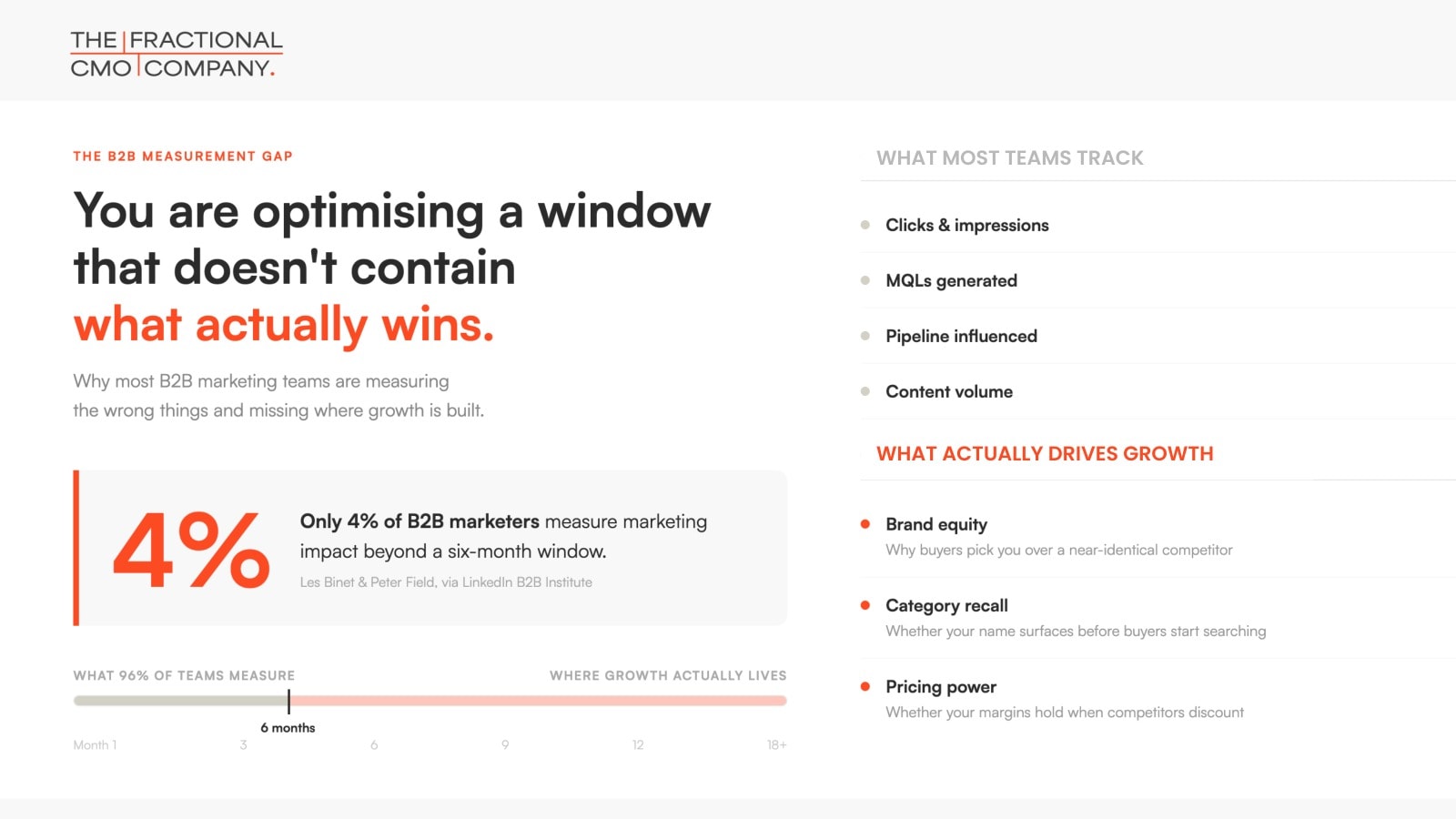
This lack of sacrifice is often driven by how we measure success. Research from Les Binet and Peter Field, cited by the LinkedIn B2B Institute, found that only 4% of B2B marketers measure marketing impact beyond a six-month window.
Think about what that means. The three factors that determine whether a B2B company can grow profitably over time all live beyond that 180-day horizon:
Brand equity: The reason a buyer picks you over a competitor selling roughly the same thing at roughly the same price.
Category recall: Whether buyers think of you before they start searching, which decides if you even make the shortlist.
Pricing power: The ability to hold your margins when the market gets crowded and competitors start discounting.
If you are only measuring what happened in the last six months, you are optimizing the short game with precision while the long game quietly erodes underneath. Most teams do not see this happening until customer acquisition costs start climbing and nobody can explain why.
In B2B companies, the sales cycle isn’t a week; it is six months, eighteen months, or even three years. Despite this, many teams treat their content like a high-volume factory, producing seven blogs a week because an SEO tool told them to. They focus on "traffic" instead of "trust."
To break this cycle, you need more than just better data; you need a better framework. Neisser’s CATS framework, from Renegade Marketing, names four qualities that distinguish effective B2B marketers. Applied to brand-building, the pattern is hard to ignore:
Courageous: Stake out a specific position and hold it, even when the pressure is to broaden and play safe.
Artful: Produce work distinctive enough that buyers can tell you apart from three competitors without seeing a logo.
Thoughtful: Understand your buyer’s specific problem deeply enough to build every message around it.
Scientific: Measure what actually reflects competitive advantage over time: brand equity, pricing power, category recall.
Most B2B teams have the Scientific part covered: attribution models, pipeline dashboards, weekly reporting. Where they fall short is at the other end. Without the courage to take a position, the craft has no anchor.
A real strategy isn’t a long document; it is just the answer to three uncomfortable questions:
Who are we for (and who are we NOT for)? If your answer covers three industries, four company sizes, and "anyone who needs growth," you do not have a strategy. You have a wish list.
What do we "own" that no one else can? If your answer also describes three of your competitors, that is not a position. That is a category description.
What have we chosen not to do? Because doing it would dilute the first two answers.
Most B2B plans don’t have clean answers to these. We are often so afraid of missing a lead that we try to be everything to everyone, which is just an expensive way of being nothing to nobody.
According to 6Sense, B2B buyers now have 16 or more interactions with you before they ever buy, and most of that happens before a salesperson even enters the room. What determines whether you make the consideration set is not how much content you produced this month; it’s the clarity and consistency of your position.
Better to be a lighthouse for ten people than a candle for ten thousand.
Those 16 buyer interactions are happening whether you have a strategy or not. Without a clear position, each one adds noise. With one, each one builds the case for why you’re the only logical choice. The gap is rarely about capability. It’s about clarity.
If your pipeline isn’t reflecting the effort your team is putting in, or those three questions don’t have clean answers yet, that’s the gap we work in. At The Fractional CMO Company, we don’t hand you a strategy deck and walk away. We come in as your fractional CMO, embedded in your team, driving both the thinking and the doing.
Quick answers on strategy vs. activity, pipeline, and when a fractional CMO fits.
A B2B marketing strategy is the set of deliberate choices that defines who you serve, what position you own, and where you choose to compete. Marketing activities (content, ads, events, social) are the execution of that strategy. The problem most B2B teams face is running activities without the strategy underneath, which produces output but not competitive advantage.
A B2B marketing strategy should include three things: a clearly defined target audience (and an explicit decision about who you’re not targeting), a differentiated market position, and a measurable long-term goal that goes beyond the next quarter.
B2B marketing fails to generate pipeline when it’s optimized for short-term metrics (clicks, impressions, MQLs) while ignoring what actually fills pipeline over time: brand equity, category recall, and buyer trust. Research from Les Binet and Peter Field shows only 4% of B2B marketers measure impact beyond six months. That’s precisely where the pipeline is built.
The most effective way to scale B2B marketing without a full-time CMO is to bring in a fractional CMO embedded in your team on a part-time or project basis. This model gives you strategic direction, execution oversight, and accountability without the cost or commitment of a permanent hire. It works especially well for B2B companies at growth stage with an active team but no strategic layer above it.
A fractional CMO brings senior marketing leadership (strategy, positioning, team direction, execution oversight) without the cost of a full-time hire. Unlike a consultant who delivers a plan and exits, a fractional CMO is embedded in the business, accountable to revenue outcomes, and involved in the day-to-day decisions that turn strategy into results.
When marketing effort isn’t translating to pipeline growth, when the team is executing without a clear strategy, or when the business is scaling and needs senior leadership before it’s ready to commit to a full-time hire. It’s also the right call when you need cross-discipline expertise across brand, demand, and GTM without building a large team to cover each function.
April 02, 2026
How relevant and useful is this article for you?